I wanted a place to share photos, videos and stories from our ancestors.
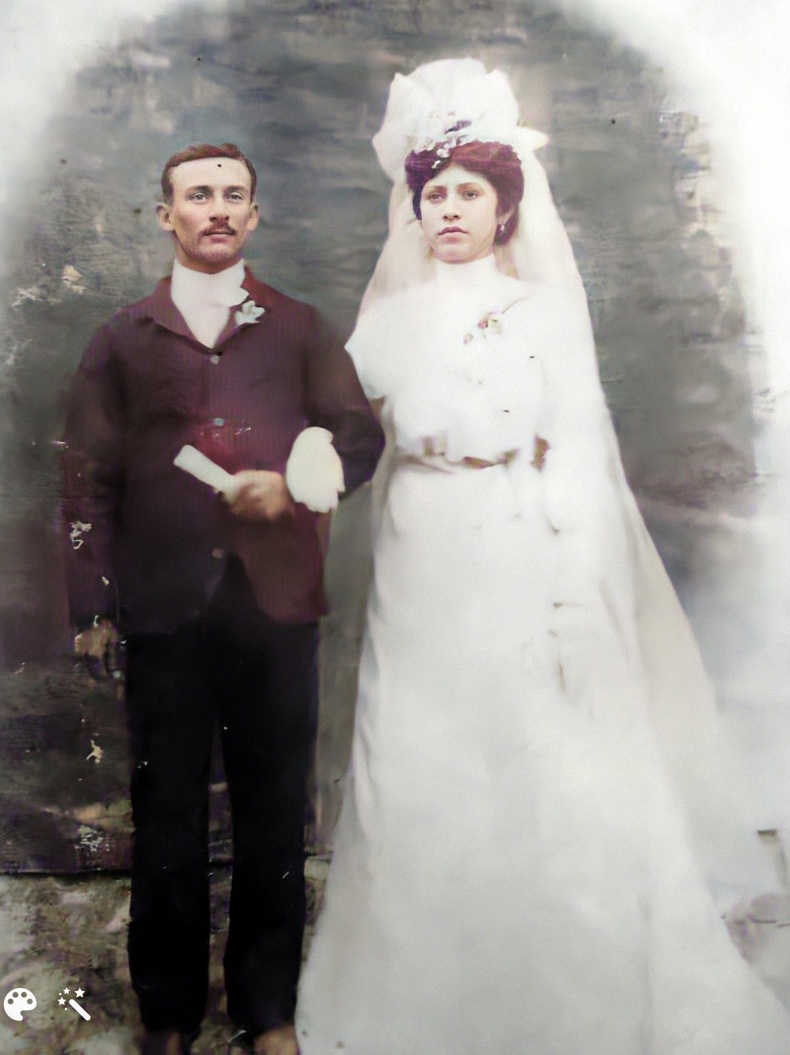
I have been interested in genealogy for a few years now, but the topic was triggered by the birth of my daughter, Renee. She was born with blue eyes like her dad, but there needed to be a recessive gene for this to happen. I started asking my grand parents, aunts and uncles about my ancestors. All by siblings and parents had brown eyes. After some questioning, I found my maternal grandmother had family with blue/hazel eyes. I found my answer, but still wanted to know more.
I have been using my heritage, which has an annual fee, to build my tree, but the search engine also finds discoveries with birth records, census, records, marriage records and other documents. My cousin’s spouse had used family search and shared his records almost 20 years ago. He had taken my one paternal ancestors line, (Garcia, Canales, Guerra) to early 1600s. I shared my interest with my cousin, Chila Covington and she (and her friend) recommended a few books. She suggested I get a copy of the book, “With All Arms-A study of the a Kindred Group by Carl Laurence Duaine. As I started reading the book I discovered, he was writing about Don Deigo Montemayor. There was a Gertrudis Montemayor Fernandez born in 1645 on my family tree, could she be a descendant of Deigo Montemayor. I started by search on my heritage, there were 5 or more Diego Montemayors! I wrote down birth dates, spouses names, sibling names, marriage and death dates to verify the right Deigo Montemayor.
My first story and connection is about Deigo and his family.
My intent is to make connections between the writings in the book and our family tree. The book is about the early genealogy and history of the Spanish explorers and the subsequent journey of life and “taming” of New Spain or Mexico.
The First Mexican Novela with Montemayor and Canales
The first connection is about page 111-112 Don Diego Montemayor, son of Juan de Montemayor and Mayor Hernandez. He was born in 1528. He first married Inez Rodriguez, second wife is Maria de Esquivel. His third wife was Dona Juana Porcallo (European spelling)(Porcayo in Mexico)de la Cerda, their daughter is Estefania de Montemayor. Juana’s father was Lord (Don) Vasco Porcayo de Figueroa nobleman and Conquistador. He died when she was young, they were living in Mazapil. Don Vasco had previously traveled with Cortes to Cuba (1512) and California (1528). He was a very prominent man. Juana, his daughter is described as an aristocrat, daughter of the Conqueror of Huasteca and young woman of Tampico when she married her husband, Don Deigo. She descended from a noble family called “Casa de las Condes”, in English translate to the House of the Counts and later the “Duques the Feria” translates to The Dukes of Feria.
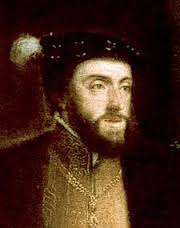
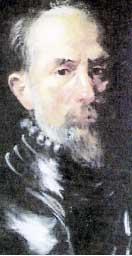
Don Deigo Montemayor arrived the new world in 1547-1548, in the lifetime with Don Vasco Porcayo de Figueroa, photo above. He was an explorer and officer. Don Deigo was made Captain probably under the service of Don Vasco who placed him in charge of Leon later named Cerralvo. There is one account that he was in charge of an exploring party and discovered the springs of Saltillo and future Monterrey on the first day of September 1555. Deigo had three marriages. His first wife was Inez Rodriguez, who he married in 1548. His first and second wife is on our family tree. Her name is Maria Esquivel, married in 1555. Their son is Diego Montemayor Esquivel. Their granddaughter Gertrudis marries Juan Canales Villa Señor in 1674, from our family tree. Their son is Captain Blas Canales de Montemayor, born 1676, from the family tree. His family genealogy can be found at www.somorprimos.com/Inclan/canales.htm
Deigo and Ines are also the 10th great grandparents of Natalia Vela. Montemayor->Rodriguez->Hidalgo (Benavidez)->Trevino->Ramirez (Saenz)->Rangel->Vela->Alvarado. And yet another connection, is the Montemayor->Rodriguez->Navarro->De la Garza->Guerra->Canales->Garcia. This would be the 10th great grandparents of Juan Canales, Mama Juanita’s father.
Don Diego was a very effective leader and trusted with expeditions. He was Castilian from Northern Spain, serving under a Basque and commanding mostly Basques. In 1580, he was appointed mayor of Saltillo. He was a law and order man, in all issues of government and slaves. He never recorded slaves and missed out on mining claims. In this book, you learn about Don Deigo, and his family scandal. The story has painted the annuals of Spanish history in the New World for generations. Don Diego had to travel quite a bit to the wilderness, protecting mines and ranches from the Indians. He was gone much of the time. Juana, his third wife had became lonely and needed companionship.
When Deigo returns home after a long absence and becomes aware of a hasty departure of Captain Don Alberto Del Canto. Loose tongues began to tell stories. Don Diego learned what everyone else seemed to know that Dona Juana, his third wife, had been intimate with Don Alberto, the Portugal Captain. He had entered her life during Deigo’s absence. The book states that in a fit of rage Don Diego drew his sword and killed his wife, Juana. He was in a panic. With Spanish custom a wrong husband had the right to kill his unfaithful wife but the right was practically never exercised. He swore not to cut his hair or beard until Don Alberto Del Canto was killed. He fled to the wilds of Nuevo Leon. He was never able to kill Del Canto, who was a great leader and liked by many. Later his own daughter, Estefania would wed Del Canto. It was Estefania who testified that her mother, Juana, had been in bed with Del Canto.
Don Deigo fled north to Cerralvo past the springs of Saltillo and of Monterrey to remote springs flowing northward to Rio Grande. Much later he made himself Governor of Nuevo Leon, occupation of Monterrey. He persuaded 15 settlers to follow him. His son, Diego de Montemayor Jr, procurator and wife Elvirada Renteria followed so did his married daughter, Estefania de Montemayor, now 18 years old. Incredible that the girl married the man who caused the family so much trouble, but Del Canto was a very attractive man. Don Montemayor appointed himself as governor of the new resurrected kingdom, more of this story below.
The handsome, humorous, colorful nobleman, Alberto Del Canto Viera married Estefania Montemayor in 1585 and in 1586 had Miguel del Canto de Montemayor (Don Diego’s grandson). Miguel would be the youngest conqueror at the age of 8! He wed Monica Rodriguez Castano Sosa Trevino in 1613 and had another Deigo Rodriguez Montemayor in 1610. He married Beatriz Gonzalez and had the third Deigo Montemayor born 1643. Finding the correct branch has been difficult because there was a total of 5 Deigo Montemayors and several Gertrudis Montemayors. Deigo’s Rodrigues Montemayor’s wife and daughter were both named Maria Gertrudis Montemayor. The only distinguishing characteristics are the year of birth and maiden names. Maria Gertrudis de Falcon Benavidez (born 1633) and Maria Gertrudis Montemayor Canales born 1654. Several family trees on my heritage listed Mozo Montemayor as Gertrudis Canales’ father. The problem is that he was dead before she was born. So I went with the family search reference, Geni World Family tree and Lopez family tree from my heritage.com. More on Don “old” Montemayor and Del Canto’s twisted history
Duaine writes that:
Royal mandate in hand Luis de Carvajal y de la Cueva controlled the region and holdings of the men in Zacatecas and Durango, also known as Nueva Vizcaya. He called Montemayor out of hiding and convened a meeting with all the captains, including Alberto Del Canto. Bitter enemies were at the same table. They were both experienced captains who knew the country. Don Luis left Del Canto as now commander of Saltillo and took Montemayor, together with his right hand man, Captain Gasper Castano de Sosa to re-enter the region on the northeast of Saltillo, now named the New Kingdom of Leon. Notice also on the family tree the name Monica Castano De Sosa who married (in 1613), married Miguel De Montemayor. It seems to be a pattern that the captain’s comrades marry the captain’s daughter or close relative.
Carvajal traveled to Saint Lucia (future Monterey) and to Del Canto’s old stomping ground San Gregoria (later named Cerralvo) and later the capital Leon. He put Montemayor in charge. At this post Montemayor was given grants and seemed on his way to fortune. He tried to clear his name of killing Don Juana. His young daughter, Estefania, testified as a girl of nine that she had only seen Captain Alberto in bed with his mother and said no more of the sword or fight. The courts cleared Don Deigo. His ambition to kill Del Canto proved to be difficult. He was younger, fearless and more powerful. He was also a great leader, practical joker and loved by his men.
Don Deigo was not successful at this post, his men melted away for lack of pay and the laws he tried to enforce. He was driven out of Cerralvo and forced back to Saltillo after 1590. He now had to witness his daughter Estefania in an unhappy marriage to Del Canto. He persuaded 12 men and families to go up the valley with everything they owned to the region dominated by El Cerro de la Silla, the resurrected Kingdom of Nuevo Leon previously held by Carbajal that had not been deserted by settlers. He now made himself Governor in 1610. Carbajal and Castano were accused of practicing Judaism. Castano left to explore New Mexico without the Crown. He returned later and was then banished to the Philippines by the Crown for his actions. He died when Japanese pirates attacked his ship.
Del Canto’s story as a boy starts in “ with all Arms”at page 114. The name Del Canto is Castillian however his legitimate 2 sons (Deigo and Miguel) took the last name of his estranged wife, Estefania Montemayor. He was born January 1, 1547 at the Praia da Victoria, on the Isle of Terceira, Arquipelago dos Azores, Portugal. His geneology records extend back to the late 1200s to the Englishman Lord John of Kent. Prince Edward of England and his side kick Lord John of Kent took an army to the Iberian Peninsula to help King Pedro of Spain to dive out the Moors. During this quest, Lord John of Kent married a Sephardic Jew of Portugal. The children changed the last name from Kent to Canto the Portuguese translation. Later Alberto do Canto changed his name to the Castillian form, Del Canto while serving under Spanish rule in New Spain or Mexico. The name Del Canto means of song or poem and must have described him.
Sometime in 1562, the boy Del Canto arrived in Zacatecas and went north to obtain work with Governor Francisco de Ibarra (Ybarra). With him he learned soldering, exploring and surviving in the rough primitive area. His willingness to work, boldness and humor quickly impressed Ibarra. He was also equipped to find Indians to work in the mines in the region. By 1576, Del Canto had explored Northeast Mexico and South Texas as far as the towns of Utopia and Bandera. In 1577, he had established the mining communities of Saltillo, San Gregorio (Cerralvo) and Santa Lucia (present day Monterrey). He assumed governorship, recruited and enslaved the indigenous people to work his mines. For the first time, the Indians had a stable food supply, shelter, clothing and protection from enemies. The ordinary Spaniard would take a common law Indian wife or a collection, but it was forbidden by the Church to have informal unions. The present day Mexican was in the making. The wealthy Spaniards brought their women from Spain or went back to get them. A new generation of white women was being born so it was possible for the upper class to start families without Indian blood. The mestizo, or mixed race, improved themselves and married other mestizo families. If a white women had a baby unusually dark they would explain it as from the Moorish blood, but probably Indian instead. The Spanish had always held a Puritan belief.
Don Montemayor explored the valley where Saltillo was founded with twenty five men and continued to explore northeast toward the modern Monterrey. Another twenty years went by and Del Canto became a captain and under the orders of Governor Ibarra re-explored Saltillo and founded the city. The settlement was on the modern site of Monterrey in December 1577 calling it Springs of Santa Lucia. Del Canto gathered Indians and would sell them against the law. He was arrested and made an example by the President of the Inquisition and Royal Council at Guadalajara. The did not last long, as Del Canto escaped and hid in the wilderness amongst the Indians. He was able to live with the Chichimeca Indians of which he was accused of enslaving to work the mines. He took parts in their hunts and wars, telling stories around the campfires and sleeping with the Indian women. While he was “playing Indian”, Don Diego de Montemayor became Captain and Mayor of Saltillo. The Grand Inquisitor died and Del Canto returned. Governor Ibarra (his friend and comrade) reinstated Del Canto as the Mayor. He quickly forgot about his arrest and went out to hunt Indians again to make into slaves defying orders from Don Luis Carvajal. Deigo de Montemayor discovered the expedition and during the night entered Del Campo’s camp and took him prisoner to the Governor’s house. Montemayor did things by the book, and would not have killed him without a court hearing. Del Canto’s band of men rode up to the Governor’s house demanding their leader, shots were fired and many were wounded on both sides. Some of Montemayor’s men tried to convince him to release the prisoner. An old man stepped up and placed a cloak around Del Canto and walked him out! His comrades refused to fire for fear of killing the old man.
Del Canto returned to gathering Indians once again only to be stopped once again by Montemayor’s men at a breakfast meeting. He did free a few Indians, but still had a good amount for a profit. Shortly after, Don Luis de Carvajal was arrested by the Inquisition. Del Canto now 39 years old married 18 year old Estefania, daughter of Juana and Deigo de Montemayor, his arch enemy. Del Canto was very attractive and seductive. The priesthood thought differently. He made the Indians work on Sundays and refused them time off to go to mass. He had secret relations with Indian women. But still between 1586-1596 fathered three children with Estefania, Miguel (1588), Diego (1590) and Elvira. In 1596, Estefania left Del Canto when Don Diego de Montemayor left Saltillo to settle Monterey in 1596. As described before, Estefania’s sons took the Montemayor name. Her son, Don Miguel became a wealthy landowner and his will in 1643 disposes of significant amount of property. Miguel does not mention his father during the will or instruction for church masses only for himself, his grandfather Deigo Montemayor and his father-in-law, Deigo Rodriguez. He lists nine legitimate children, 2 illegitimate daughters and his wife Monica Rodrigues and Inez at the end. Del Canto died in 1611 at his Hacienda de Buena Vista, Saltillo Coahuila. Many of the grandchildren of Alberto del Canto married the grandchildren of Marcos Alonso de la Garza. See the family tree ancestors of Juan Cavazos, Pedro, and Blas de la Garza.
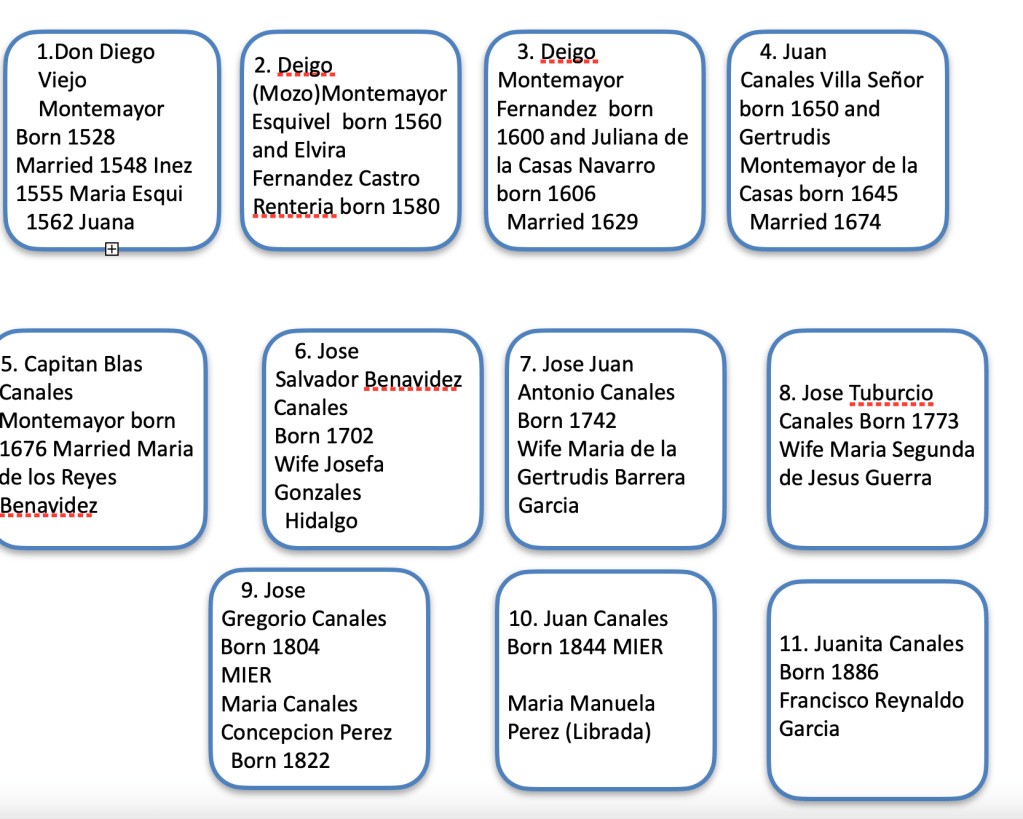
I will post the Montemayor>Del Canto>de la Garza>Guerra>Canales line later.

 Garcia Guittar Family History
Thank you Becky so very much. I can’t even imagine the time you have spent researching.
LikeLike