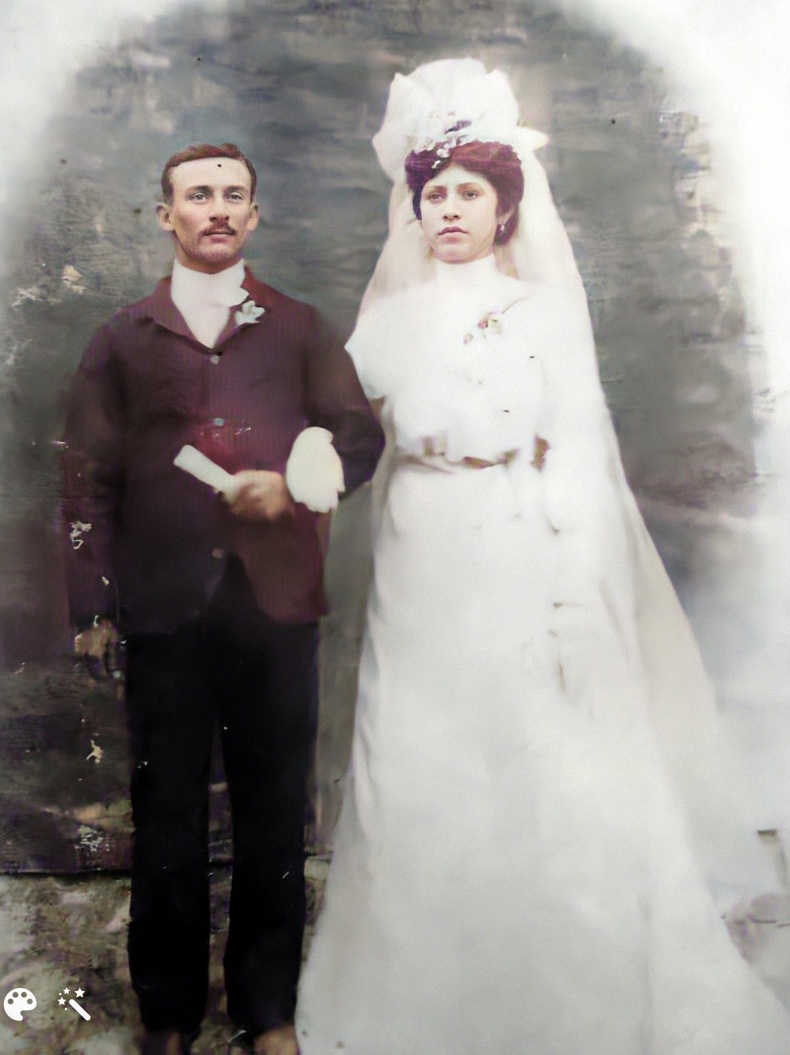
The Royal Connection or Not?

Once I learned about the possible connection with Spanish royalty, I began reading about King Fernando and Queen Isabella. We maybe related to King Fernando but not Queen Isabella.  Carl Duaine’s Book “With all arms”,  has a good account of the illegitimate children of King Fernando. Duaine translated the work of Manuel Morales Munoz from Los Altamiramos – Historical Archives.

Las Estradas

“The founder of the line in New Spain was Don Alonso de Estrada, who was a native of Ciudad Real, in the kingdom of Castile, where he was born at the end of the fifteenth century. He was the natural son of Fernando, the Catholic, King of Aragon, by the account of several historians and so recorded in the Holy  Inquisition (Historical Archives of the Nation in Madrid Testimony 1501. No. 17) and Dona (Maria) Luisa de Estrada, daughter of Fernan, Duke of Estrada, head of the House of Estrada, ambassador of the Catholic Kings to England, sent especially to negotiate the second marriage of Dona Catherine of Aragon to Henry the VIII of England. Dona Catherine of Aragon is King Fernando and Queen Isabellas’s daughter. She has a fascinating story as well, capture part of her story on Starz in “The Spanish Princess” or in the book by Philippa Gregory, ” The Constant Princess”.

I also read the Queen’s Vow by CW Gortner, on page 232-234, the story is told in a dramatic depiction of the details. Fernando has been away to Aragon and delayed returning to Queen Isabella in Castile, where royal decisions needed to be made.  Her informant and advisor tells Queen Isabella,  “His majesty has been lying to you for months. He has a mistress in Aragon with child, the mistress has begged him to stay.” The informant continues, “I thought he (the King) would have told you about his bastard son by another woman before your marriage? It’s not a secret, all of Zaragoza knows about him, even King Juan has the child in court and give him gifts.”  Queen Isabella angrily removes the informant from count as her advisor. When the king finally arrives, she confronts King Fernando. He replies, “ I was going to tell you about the boy. He is 2 years old. It was a moment of weakness of madness… I needed comfort. I do regret it.” He believed the boy was his. Queen Isabella orders him to see to his “upkeep”.  HIs name is Alfonso (Alonso). He continues to say about this new affair, “It meant nothing to me.”

She reminds him that  while he needed comfort, she was navigating her mom’s health care, their daughter and the crisis of Enrique’s death, her half brother and King of Castle, 

They do have a rough patch, but are forced to work together to declare war and protect their holdings from a new threat. They do eventually reconcile, and Queen Isabella knows she must have a male heir for the kingdom. Aragon may not authenticate her daughter as the Queen, only males could be kings. In Castille, women could rule, but not in Aragon.

There is also memory of the affair, in CW Gortner’s book, The Last Queen. Juana, Isabella’s daughter states, “ My father adored my mother but he had a mistresses, one bore a son and another a daughter named Joanna. The queen had both children brought to court to be reared as royalty. QueenJuana is also dealing with the newly discovered affair between her husband, King Philip and his court lady. Juana is devastated and is trying to get over it, wondering how her own mom might have felt and reconciled. Juana is told about her sister, Princess Isabella, who was next in line to the throne, has died.  King Philip, (Juana’s husband) desperately wants  her to petition the courts that he should be the next in line to the throne. Another story to follow and learn about. 

Don Alonso de Estrada gave outstanding service to Charles V, who named him treasurer of the New Spain and in October 1524, charged him with governing New Spain. He as born in 1470. Ana Estrada, his daughter was born in 1498 and marries Juan in 1525 in Spain, another record stated 1511 in Mexico City. More to research here. Cortez, Ponce de Leon and Marcos Aguilar also governed in New Spain, but eventually the office returned to Alonso. Here is the possible family lines:
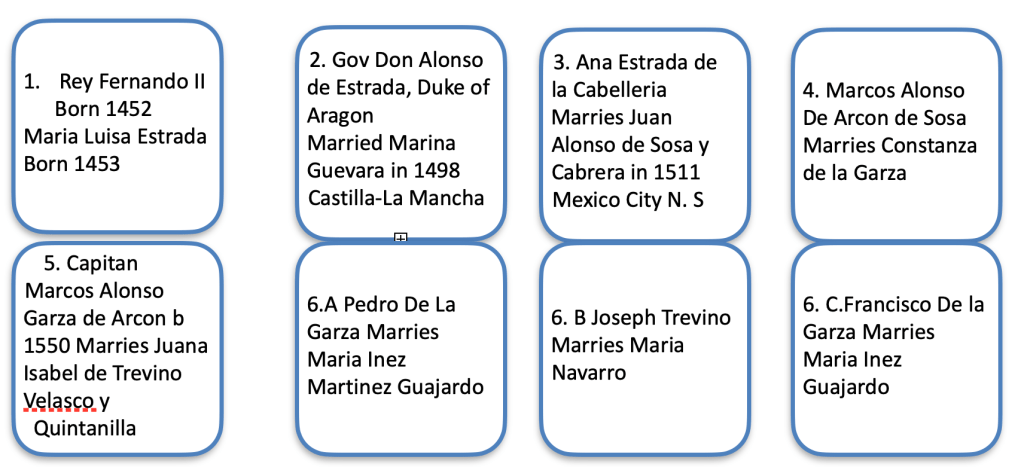
I also found a disturbing on the history of Marcos Alonso de Arcon de Sosa y Estrada.  There is some notes that 4. Marcos Alonso de Arcon y Estrada and Constanza were accused of practicing Judaism and Constanza may have been burned during the Inquisition.  Some biographies were not sure of his ancestry and notes that they must have tried to keep it secret. Is this why he came to Mexico?https://www.familysearch.org/photos/artifacts/68169479?cid=mem_copy

There is MUCH discussions about the parents of 4. Marcos Alonso de Arcon de Sosa. Some claim that his parents were already in Mexico, when he was born in Spain. Don Alonso Estrada was named treasurer of New Spain at the end of 1524, Marcos Alonso de Arcon de Sosa was born in 1525, in Spain. I could speculate he is Don Alonso’s son and not Ana Estrada’s son.  There is not a baptism record in Mexico, but he was born in Spain.  I see many family trees that do include him as the son of Juan Alonso and Ana’s son, but no proof. Maybe he was actually a nephew or illegitimate son (left in Spain), while Don Alonso traveled to the New World, but much more genealogy research is needed to confirm.   See interesting websites. I have a few sources that state that Marcos and Juana were Sephardic Jews, their story follows.

https://www.geni.com/discussions/197136

The primogenitor of the de la Garza Falcón family was Captain Marcos Alonso Garza y del Arcon, a Spanish nobleman, native of Lepe, province of Huelva, Spain. He arrived in Mexico City about 1550 becoming very active in Spanish court social circles and marrying into the prominent Trevino family. He married Dona Juana de Trevino Quintanilla, daughter to Capitan Diego de Trevino and Dona Beatriz de Quintanilla. Her brother was General Jose de Trevino. In 1569, he and his wife arrived in Durango City in the province on Nueva Viscaya, present day state of Durango. Two sons were born Don Alonso de Trevino and Don Josef de Trevino. Notice that the children took their mother’s family name Trevino, since it was much more prominent. Could it also have been the family name tied to their past in Spain? Pedro was also known as Pedro de la Garza Falcon Trevino. Falcon is assumed to be the same as Arcon/Argon from the Royalty connection perhaps? He also drops the Sosa name which another relative also dropped the Sosa name because it could have been a Jewish reference.

Capitan Marcos Alonso Garza y Arcon was a miner by trade and he arrived with family to settle, Real de Mapimi, a mining town in the province of Nueva Viscaya (Durango). His three children included Don Pedro de la Garza, Dona Juana Trevino and Do Blas de la Garza Falcon. In 1603, Don Marcos Alonso and his family moved to La Hacienda de San Francisco in the jurisdiction of Monterrey, Nuevo León, México. His two sons, Alonso and Blas bought the hacienda. After his wife’s death, Don Marcos remarried Dona Catalina Martinez Guajardo and had 2 daughters, Dona Juana de la Garza and Dona Isabel Martinez. She took her mother’s name because it was very prominent in Nuevo Leon. Their families contributed to the settlement of Nuevo Santander and the pacification of the Indians. I see another account that the marriage to Catalina was first and then Juana. Will have to confirm this.

5. Capitan Marcos Alonso and Juana Trevino started 7 family lines in the Garcia Family tree. I have shared 4 lines. There is 3 others that start with Joseph Trevino (349), Francisco de la Garza (347) and Capitan Alonso de la Garza. So even if some of the connections are not correct there is 6 other lines that start with Marcos and Juana with a possible connection to Ana ->Alonso Estrada and King Fernando.

https://www.familysearch.org/photos/artifacts/123124538?cid=mem_copy

Another theory, as to why the last name Alons(z)o was totally abandoned by the family is a mystery, but it may have to do with the fact that the Alonzo last name of Lepe, Huelva, Spain was associated with the Jews. Hernando Alonzo financed and aided Hernan Cortez in his actions. After the conquest of Mexico City, Hernando Alonzo, a well known Jew in the New World, was becoming too wealthy and powerful, and thus a threat. Hernando Alonzo was burned alive under orders of the Inquisition. While no link has been established between Hernando Alonzo and Marcos Alonzo, the name may have been changed for protection. Source: Geni.com

6. A Pedro de la Garza marries Maria Inez Guajardo (also known as Inez Rodriguez) have a son, Pedro de la Garza marries Maria Luisa de la Rocha Robles-> Pedro de la Garza de la Rocha marries Ana Diaz Botello->Maria Josepha de la Garza (353)marries Diego de Hinojosa Cantu->Jose Manuel Hinojosa de la Garza->Manuel Angel Hinojosa Chapa->

Maria Anastasia Lucia Hinojosa->Maria Leonor Gonzalez Hinojosa->Maria Concepcion Canales->Juan Canales-> Juanita Canales, my paternal grandmother.

Pedro and Inez also have a daughter named Elena de la Garza.

 6. D Elena de La Garza marries Capitan Juan Cavazos->Pedro Garcia Avila marries Margarita Cavazos->Joseph Garcia de Avila D Cavazos->Capitan Francisco Garcia Salinas (477)->->Ana Maria de Garcia->Maria Teresa Trevino Garcia (235)->Maria Josepha Victoria de Jesus Hinojosa** (117)Trevino ->Jose de los Santos->Maria Ursula Vela->Dario Vela->Natalia Vela, my maternal grandmother.

Maria Josepha** Hinojosa also has->Maria Feliciana Hinojosa(105)->Jose Rafael Pena->Jose Marcelo Pena->Maria de los Santos Pena->Ramon Alvarado, my maternal grandfather.

 6. D Elena de la Garza also has Maria Cavazos de la Garza (341) ->Antonio Guerra Canamar de la Garza-> Francisco A Guerra-> Jose Juan Manuel Guerra->Maria Segunda de Jesus  Guerra->—>Jose Gregorio Canales->Juan Canales->Juanita Canales

There is also 6. E Capitan Blas de la Garza, he also contributed to a the Garcia family line.  Blas and Beatriz had Lazaro de la Garza->Lucas de la Garza 270->Maria Lucia Gertrudis de la Garza->Jose Francisco Angel Garcia->Pedro Ignacio Garcia->Jose Encarnacion Garcia->Cecilio Garcia->Francisco -> Reynaldo Garcia.

  Lazaro also had Maria de la Garza 260, who married Tomas Garcia ->Cristobal Garcia->Nicolas Antonio Garcia->Juan Francisco Angel Garcia->Pedro Ignacio Garcia->Jose Encarnacion Garcia->Cecilio Garcia->Francisco Garcia, my paternal grandfather. Blas and Beatriz had about 17 children.

The photo below is of another son, Capitan Blas Maria de la Garza Falcon Villarreal. His monument in Corpus Christi is a symbol of friendship and the first successful Spanish colonizer with a land grant. King Felipe of Spain appointed a Governor to help keep the French out of the region. The Governor founded 23 settlements, but only Capitan Blas was successful in establishing the first and famous South Texas ranch industry . To the region, he brought his family, longhorn cattle, horses, farming tools and other domestic animals and taught the region about cattle drives, branding and corrals.
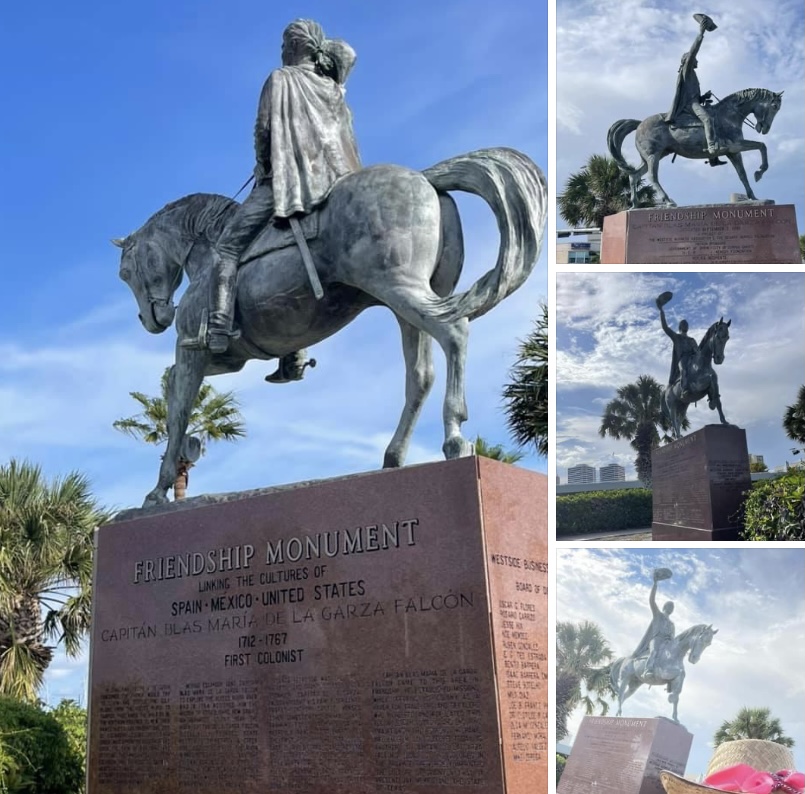
Capitan Blas de la Garza

 I would like to encourage all of you to send me stories about our family, maybe its about Tia Neta, Mama Juanita, Papa Ramon. I would like to include a more recent family story with the genealogy. 
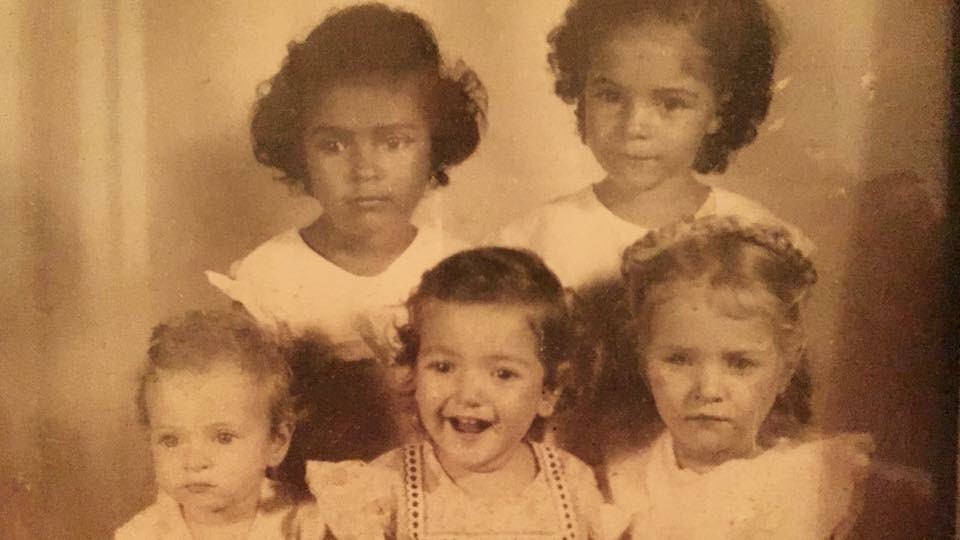
Armando’s Daughters – Gertrudis (Tula) Teresa(Tere), Berta, Lucila (Chila) and Beatriz Garcia

This next story was told to me by Chila Covington and Tere Weber,  my cousins. Chila was 3 years old when she went to live with Mama Juanita, “Mama Grande”, after her 38 year old mother passed away. Her friends were Frankie and Luis (my brothers), but she recalls that Mama Juanita wasn’t happy with them playing together, she thought the boys would be too rough. Her other four sisters, Tere, Beatriz, Berta and Tula went to live with Tia Neta (Ernestina), about 3 blocks away.  Their dad, Armando Garcia provided financial support and their house. Janie Mendez, a cousin lived with Tia Neta. Since Janie was older, she was able to help with meals and cleaning. Janie took good care of the girls, naming her own daughter Berta. in the photo below, I am with my twin brother on Janie’s special wedding day.
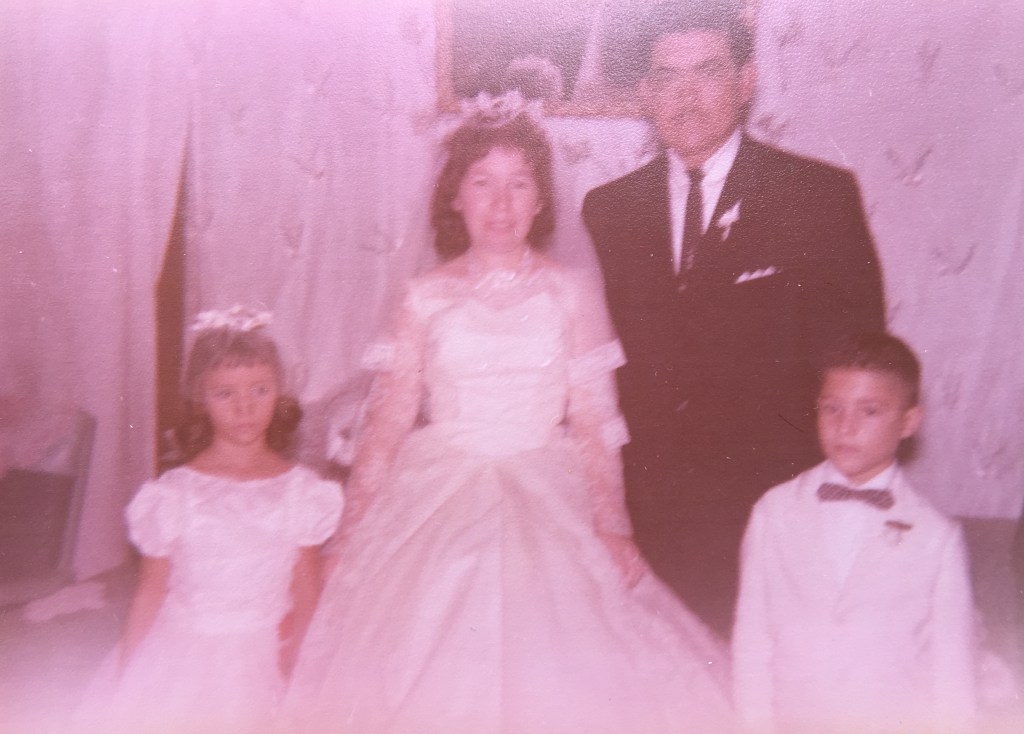
Janie and spouse,Alonso Martinez with Becky (me) and by twin brother Reynaldo or Ronny
Wedding Cotulla Texas, circa 1963

 My paternal grandmother, Mama Juanita loved theater. She would put on annual productions that would be fund raisers for the church. Mama Juanita learned the choreography from the different regions of Mexico during her annual visits to Mexico accompanied with Tia Neta. The production included regional dances and poems with children participation. One of the  young girls would be crowned the queen after raising the most money for the church. Janie was crowned queen during the “fiesta patrias” and later she recalls when Tere was 13 years old, she won the award and crown. Berta, Beatriz and Chila were the maidens following behind holding up her train. Chila wore a fluffy yellow dress sewn by a Olivia, Tia Petra’s daughter, She was a seamstress from Mexico and Mama Juanita’s niece and Armando’s cousin. She always came to help during these events as she was a seamstress for theatrical productions and movies in Monterey. Tere wore a beautiful white dress, Beatriz a blue dress, Chila a yellow dress, and Berta a pink dress. Tula was dressed as La Virgen de Guadalupe.
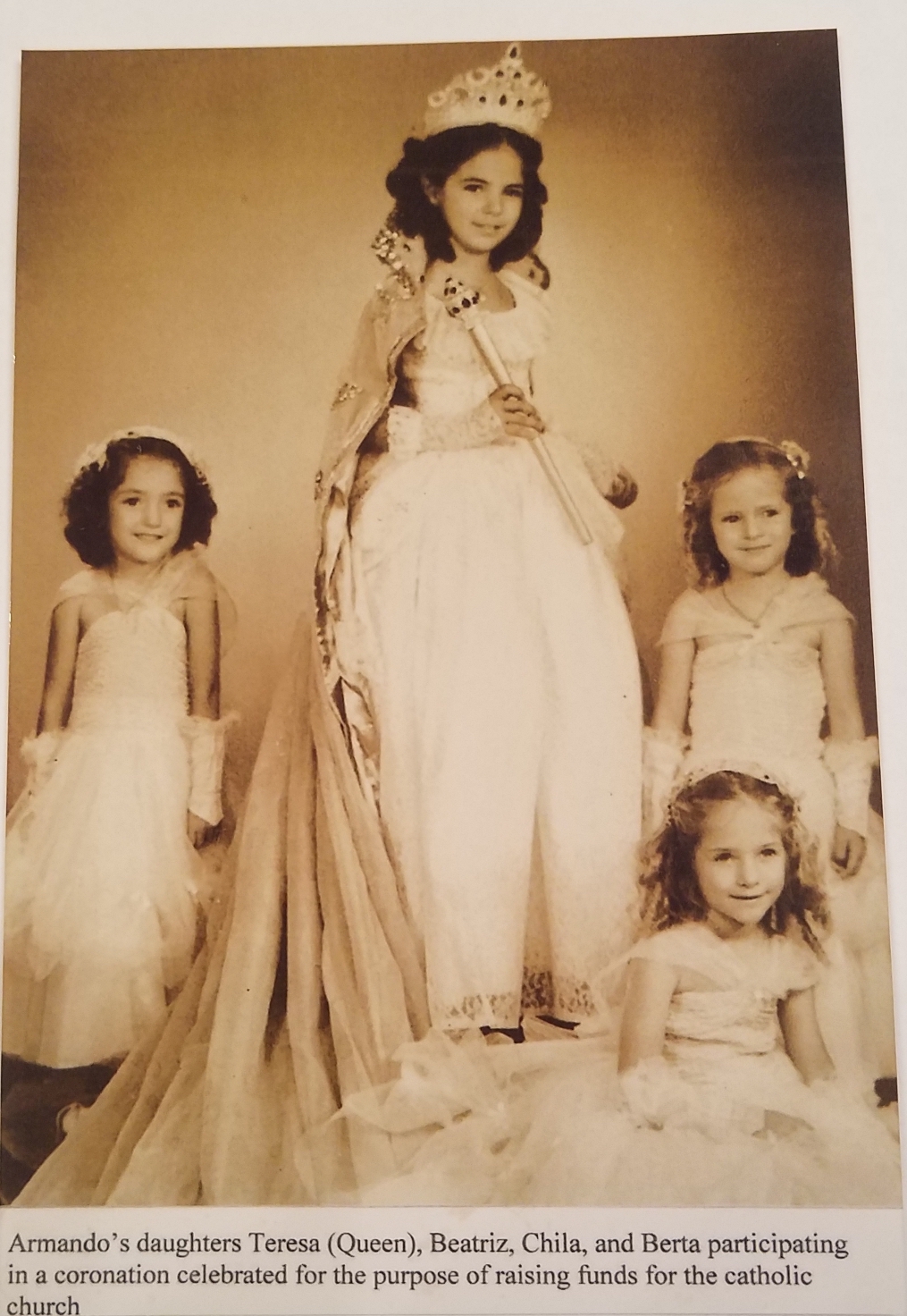
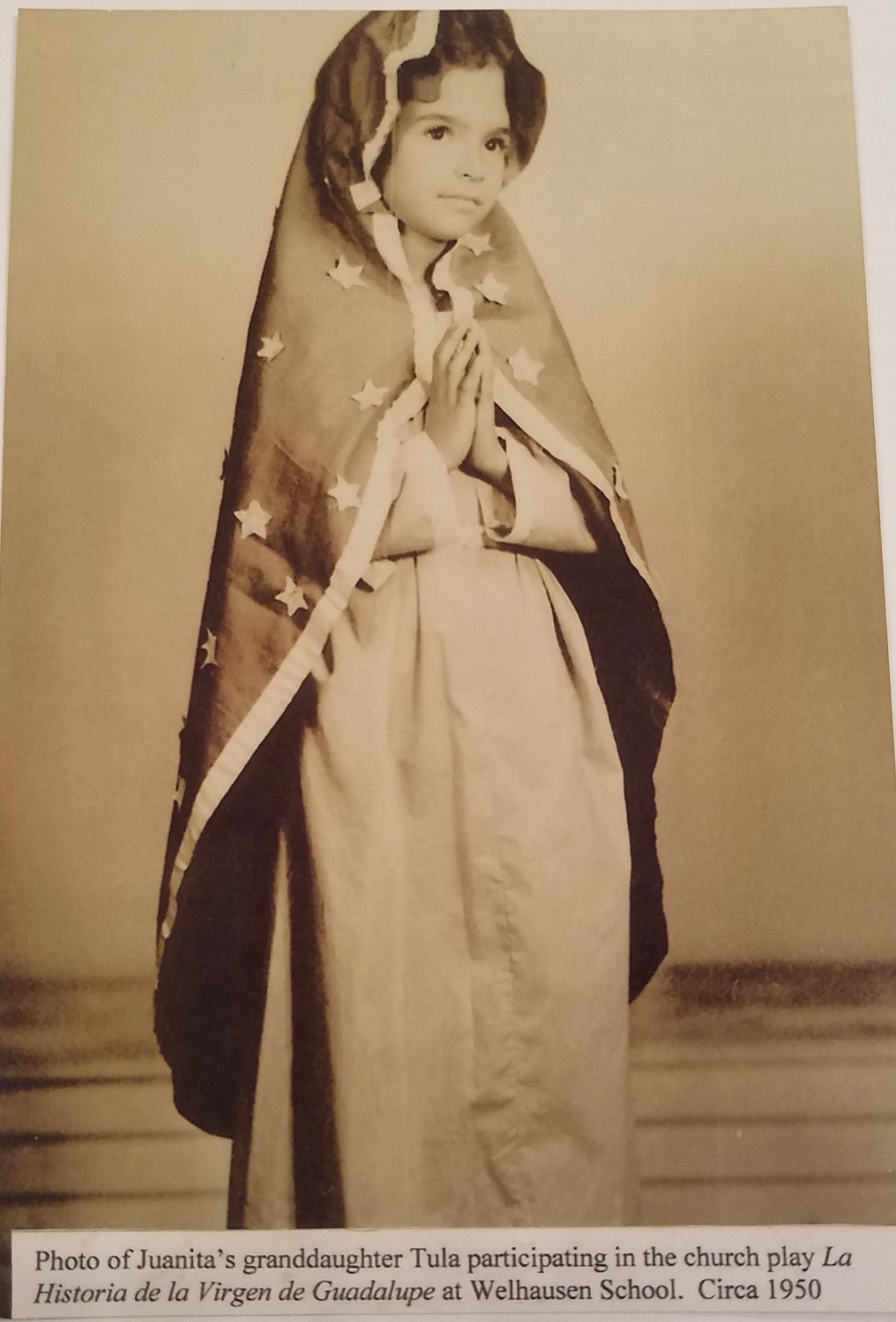
One of the other theater stories, involved her dad, Tia Armando. He was portraying a character that got shot. The girls were upset, they thought  the killing than been real and not just a play. Mama Grande, as Mama Juanita was called, would assist in recitals of patriotic poems, dances, and  songs, such as “El Grito”.  The theater production profile was a melodrama. Armando was dressed as the bride. It was an all male ensemble. The groom was Tom Mendez, who was in high school and a nephew of Trinidad or Trine.  People enjoyed the hilarious production until the girls started crying.

Queen Tere with sisters at Welhausen School, Cotulla, Texas

Their dad,  Armando was most handsome in a white coat as Master of Ceremonies. He loved theater, drama and especially comedic situations.  Well, come to think about it, ALL the Garcia sons were happy, comedic individuals!

Another yearly event that  Mama Grande produced was on Mother’s Day also at the Welhausen School Auditorium. She would have community involvement with participation of patriotic songs, and especially poems about mothers. Tere recalls how she recited a long poem about the death of a mother. Of course the audience cried with the obvious connection and  empathy knowing Tere’s family history and her 4 sisters. Tere was very dramatic and loved the drama, emotionally moving the audience since they knew the history of the girls being …motherless. These  events also had Spanish dances in the evening.

Tia Neta and Mama Grande would travel all over Mexico during the summers and take 2 or 3 of the girls including Janie along on the trips.  Mama  Grande would visit theater productions, many churches, and museums. etc. She loved art, culture and history.  She was a teacher before she married. She was  teaching in the ranch where she met Papa Francisco. Of course all her daughters,  (Ofelia, Ernestina, and Consuelo)  taught children and adults in the community.
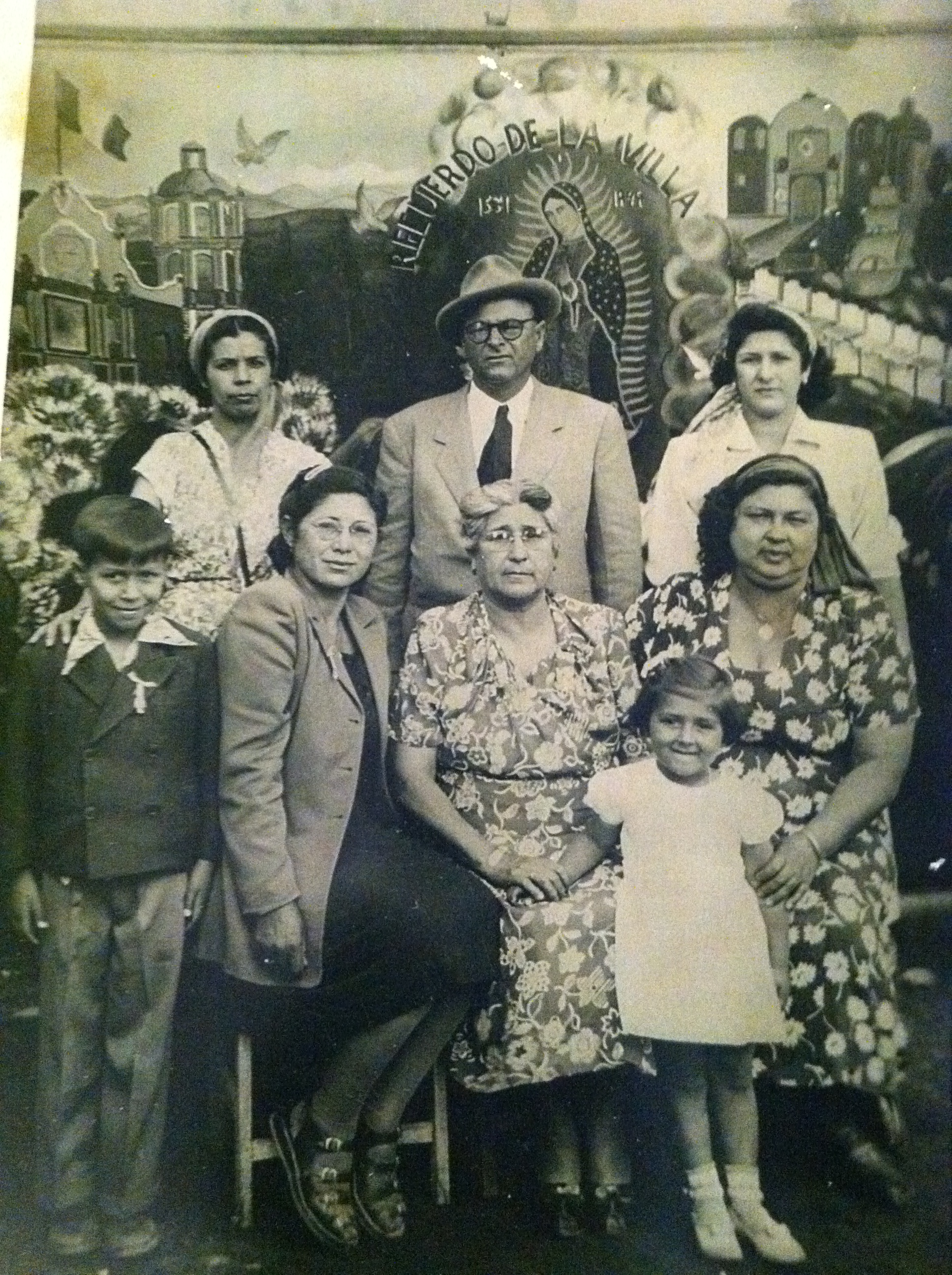
The photo above included: (circa 1940) Back row: Olivia-grandmother’s niece and seamstress from Mexico, Ruben Mendez – Ernestina’s husband and their uncle being their mom’s brother. Consuelo or Tia Chelo.

Front row: Roberto-Olivia’s son, Ernestina or Tia Neta, Petra – Mama Juanita’s sister. She also had another sister named Faustina who was a natural healer or by the town called her a “bruja”.

Corina- Tia Chelo’s daughter.

Virginia-grandmother’s and Tia Neta’s good friend and best baker of empanadas.

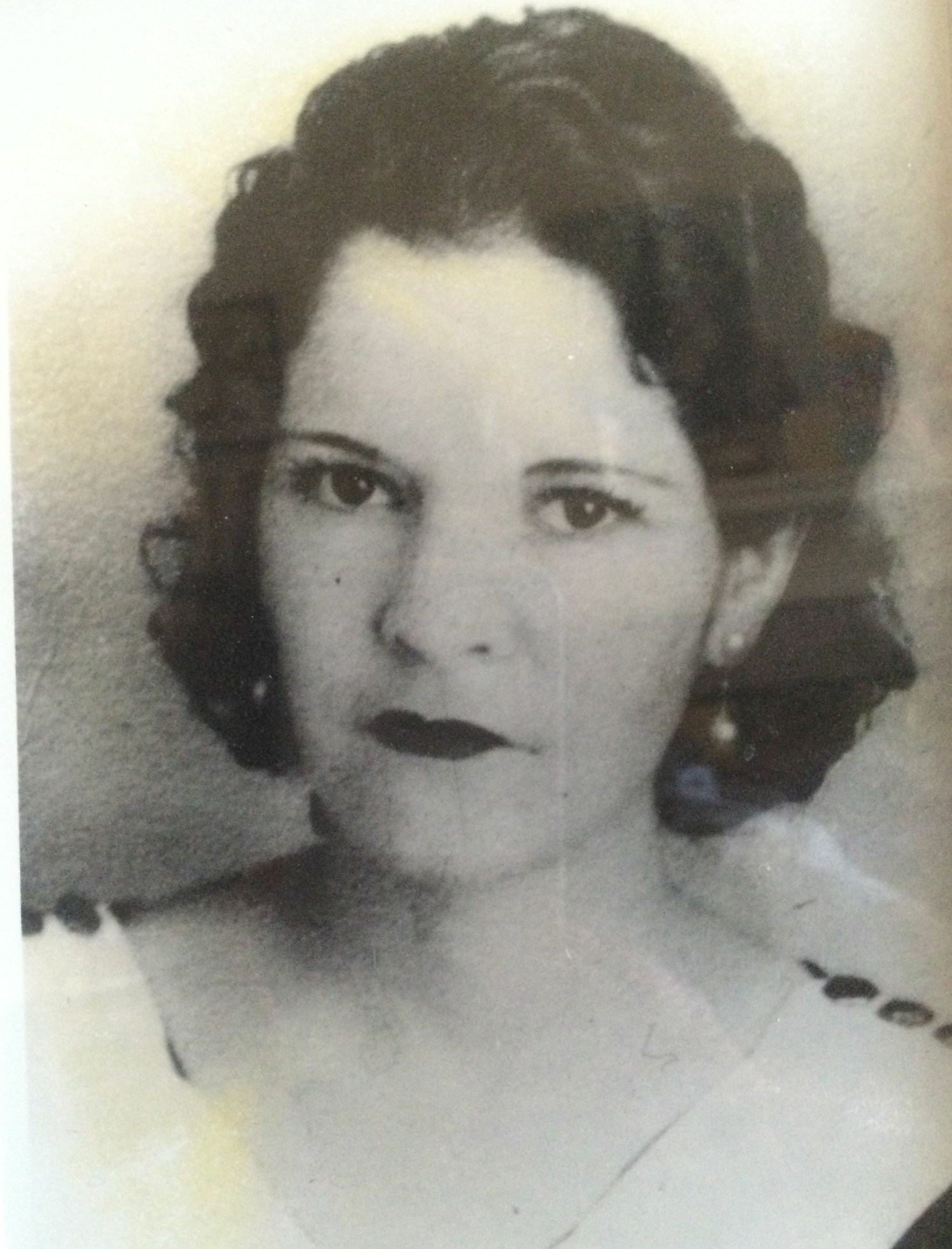
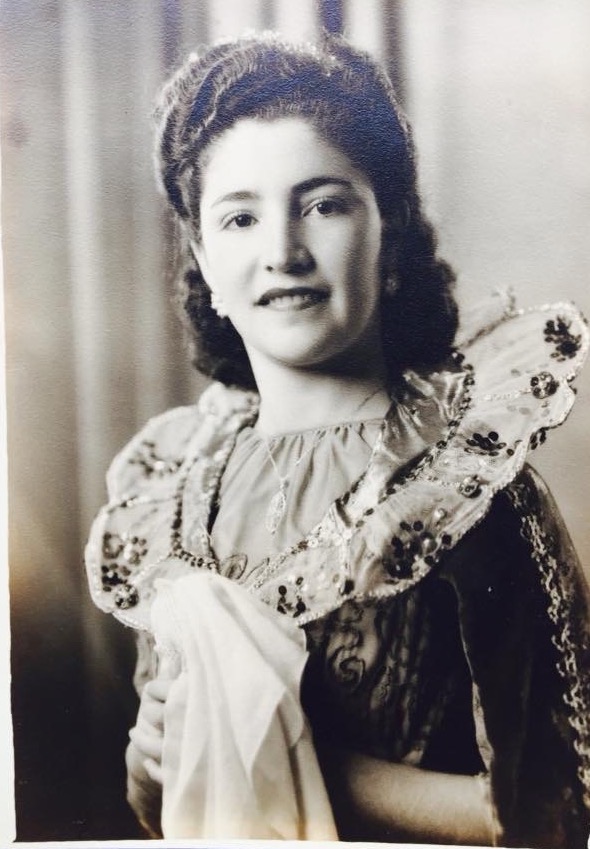
My mother is Tomasita Alvarado, 1923-2018, (on left) in Queen’s attire, from a very similar church event from her home town in San Deigo, Texas, circa 1940. I  also included a photo of my cousin’s Mother, Trinidad Mendez, 1910-1948 (on right).   Beautiful mothers from the inside out!
More family lines to Don Deigo Montemayor

As I have continued my work and research on Don Deigo’s family line, I did discover 7 more family lines that start with Don Deigo. I will share 4 more family lines that demonstrate how we are related to Don Deigo. This first line starts with Montemayor’s daughter, Estefania and her witty spouse, Alberto Del Canto, from the story in the first post.

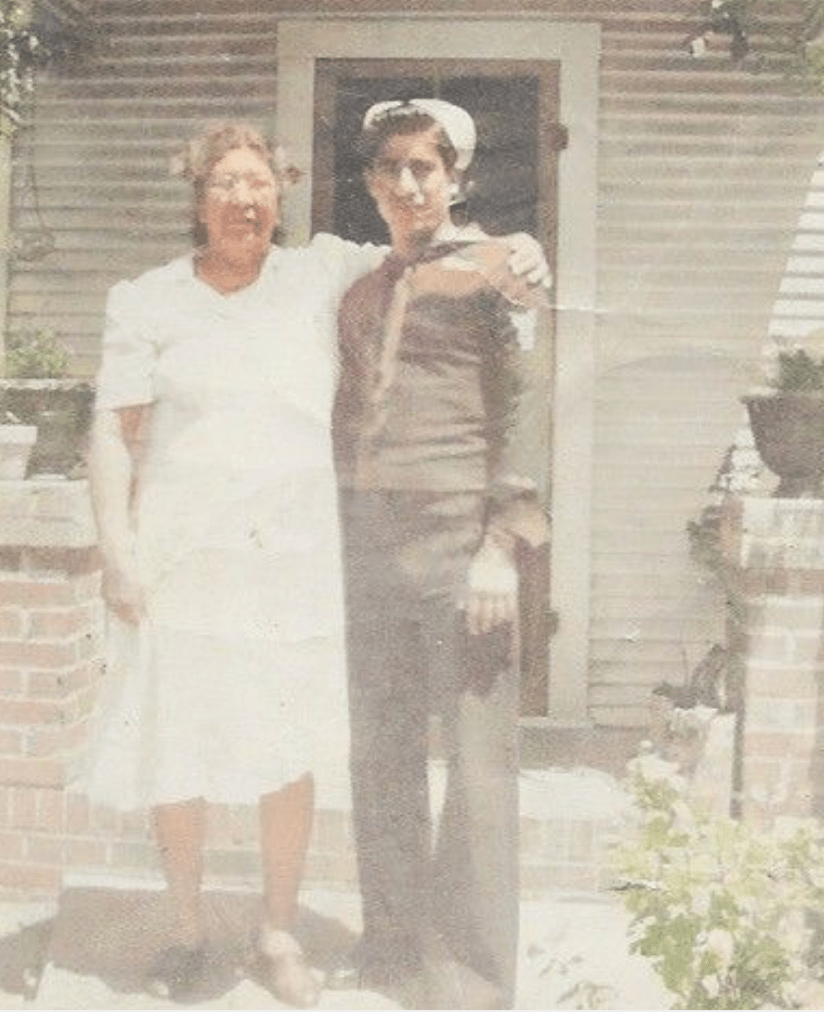
Mama Juanita Canales Garcia and Reynaldo C. Garcia abt 1945
Deigo Montemayor ->Estefania del Canto->Francisco Garcia
Deigo Montemayor -> Tomas Garcia->Francisco Garcia

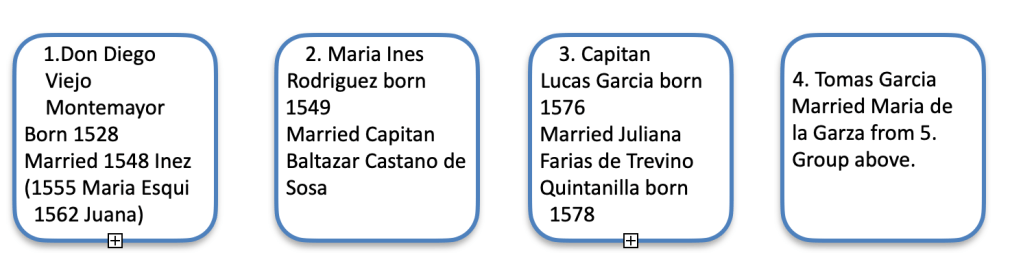
In this family line above, you also see in group, 5. Maria de la Garza marries Tomas Garcia. Tomas was Diego and Ines’s great grandson. His father was Lucas Garcia, see group 3 above. Duaine reports in his book, that Lucas was born in Nueva Galicia or the Tampico region about 1570. He married Juliana de Quintanilla, probably a Sephardic Jew. Lucas was familiar with the local Indian languages, which he spoke fluently. His brothers and him chose their maternal surname Garcia-Quintanilla and NOT use “de Sosa” from their Jewish father, Balthazar de Sosa. My 23 and me report does show I am, 1.7% Ashkenazi Jew and for my daughter, shows .9% Ashkenazi Jew. I am 64% Spanish and Portuguese. I big surprise to be both a fragment of Jewish and Portuguese decent. There is some sharing of genetic code between the Ashkenazi and Sephardic Jews. I am not an expert in this field and plan to study and learn more. Duaine shares that Queen Isabella resented the Jews and Moors and didn’t think they would be loyal to her so the plan was to “drive them out of Spain” and send to the New World. These New Christians, as they were called settled in the Tampico area and the De Sosa family was important. I will also share that in the book, ” The Queen’s Vow” by Gortner, Queen Isabella of Spain, used the Jewish banks to finance her Moorish war to regain the region of Granada. In this book, she hesitantly agrees to the Inquisition which began to remove and eliminate the new Christians that still practiced Jewish beliefs or converts. I am sure religion, belief and practices played a big role in shaping the New World. Not using De Sosa as a last name is just an example of the discrimination or injustices that could have been displayed.

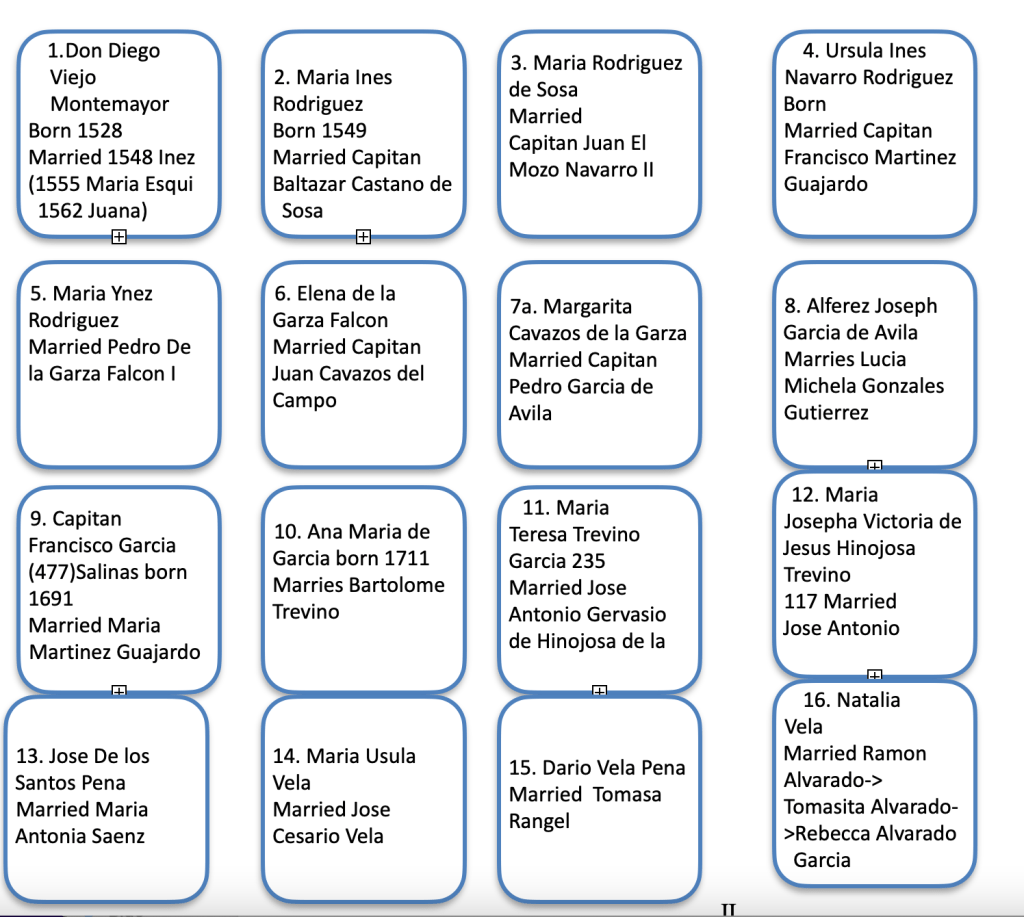
The two family lines that follow, start with Don Deigo, one ends with Natalia Vela, my maternal grandmother and the other ends with Juanita Canales, my paternal grandmother. Margarita (7a) and Maria (7b) are sisters having the same parents, see grouping 6. Margarita is seen with Natalia’s family line and Maria is seen with Juanita’s family line. So if you go back several generations, they had the same 5th or 10th great grandparents. Elena de la Garza and Capitan Juan Cavazos del Campo. I will share some of their stories in the next posts.

Papa Ramon Alvarado and Tomasita Alvarado Garcia abt 1941
Deigo and Inez->Margarita de la Garza->Vela->Natalia Vela Alvarado
Deigo and Inez->Maria de la Garza->Juanita Canales Garcia

National Grandparents Day Worksheet completed by Tomasita.

Tomasita A. Garcia completed a middle school worksheet for Sara, my daughter in about 1994.

She told the story of her father, Ramon Alvarado. She wrote, “my dad worked in a cotton gin. I would walk across town to take lunch to him. One day my hat got caught in the giant blower and blew away. I was so embarrassed, but I never got close to the blower again. I also remember young boys and men leaving home to go to the work corp established by FDR to give people jobs. I also remember, I got typhoid fever and almost died. The first medication didn’t work. I got some new medicine maybe penicillin and after 4 months, I was well.”

Welcome to the Garcia Guittar History Blog

I wanted a place to share photos, videos and stories from our ancestors.

I have been interested in genealogy for a few years now, but the topic was triggered by the birth of my daughter, Renee. She was born with blue eyes like her dad, but there needed to be a recessive gene for this to happen. I started asking my grand parents, aunts and uncles about my ancestors. All by siblings and parents had brown eyes. After some questioning, I found my maternal grandmother had family with blue/hazel eyes. I found my answer, but still wanted to know more.

I have been using my heritage, which has an annual fee, to build my tree, but the search engine also finds discoveries with birth records, census, records, marriage records and other documents. My cousin’s spouse had used family search and shared his records almost 20 years ago. He had taken my one paternal ancestors line, (Garcia, Canales, Guerra) to early 1600s. I shared my interest with my cousin, Chila Covington and she (and her friend) recommended a few books. She suggested I get a copy of the book, “With All Arms-A study of the a Kindred Group by Carl Laurence Duaine. As I started reading the book I discovered, he was writing about Don Deigo Montemayor. There was a Gertrudis Montemayor Fernandez born in 1645 on my family tree, could she be a descendant of Deigo Montemayor. I started by search on my heritage, there were 5 or more Diego Montemayors! I wrote down birth dates, spouses names, sibling names, marriage and death dates to verify the right Deigo Montemayor.

My first story and connection is about Deigo and his family.

My intent is to make connections between the writings in the book and our family tree. The book is about the early genealogy and history of the Spanish explorers and the subsequent journey of life and “taming” of  New Spain or Mexico.  

Don Vasco Porcayo

The First Mexican Novela with Montemayor and Canales

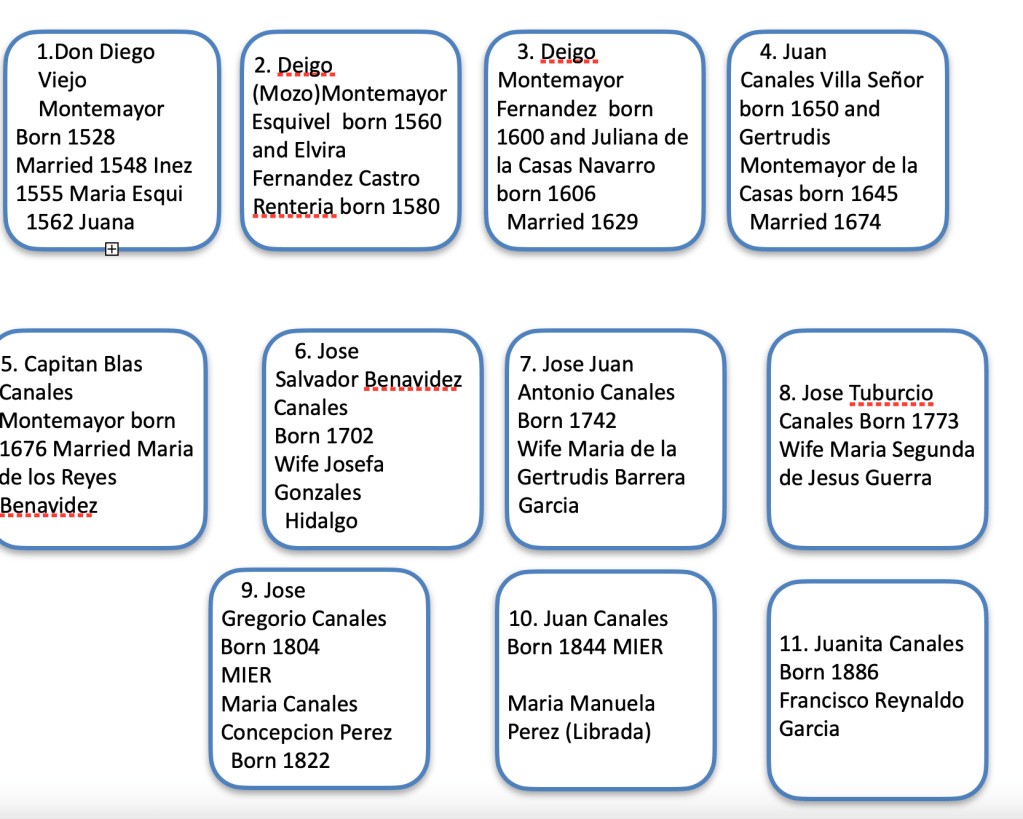
The first connection is about page 111-112 Don Diego Montemayor, son of Juan de Montemayor and Mayor Hernandez.  He was born in 1528. He first married Inez Rodriguez, second  wife is Maria de Esquivel.   His third wife was Dona Juana Porcallo (European spelling)(Porcayo in Mexico)de la Cerda, their daughter is Estefania de Montemayor.  Juana’s father was Lord (Don) Vasco Porcayo de  Figueroa nobleman and Conquistador. He died when she  was young, they were living in Mazapil.   Don Vasco had previously traveled with Cortes to Cuba (1512) and California (1528). He was a very prominent man. Juana, his daughter is described as an aristocrat, daughter of the Conqueror of Huasteca and young woman of Tampico when she married her husband, Don Deigo.  She descended from a noble family called “Casa de las Condes”, in English translate to  the House of the Counts and later the “Duques the Feria” translates to The Dukes of Feria.  

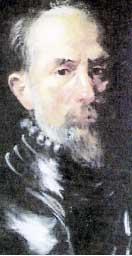
 Don Deigo Montemayor arrived the new world in 1547-1548, in the lifetime with Don Vasco Porcayo de Figueroa, photo above.  He was an explorer and officer.  Don Deigo was made Captain probably under the service of Don Vasco who placed him in charge of Leon later named Cerralvo. There is one account that he was in charge of an exploring party and discovered the springs of Saltillo and future Monterrey on the first day of September 1555. Deigo had three marriages. His first wife was Inez Rodriguez, who he married in 1548.  His first and second wife is on our family tree. Her name is Maria Esquivel, married in 1555. Their son is Diego Montemayor Esquivel. Their granddaughter Gertrudis marries Juan Canales Villa Señor in 1674,  from our family tree. Their son is Captain Blas Canales de Montemayor, born 1676, from the family tree. His family genealogy can be found at www.somorprimos.com/Inclan/canales.htm 

Deigo and Ines are also the 10th great grandparents of Natalia Vela. Montemayor->Rodriguez->Hidalgo (Benavidez)->Trevino->Ramirez (Saenz)->Rangel->Vela->Alvarado. And yet another connection, is the Montemayor->Rodriguez->Navarro->De la Garza->Guerra->Canales->Garcia. This would be the 10th great grandparents of Juan Canales, Mama Juanita’s father. 

Don Diego was a very effective leader and trusted with expeditions.  He was Castilian from Northern  Spain,  serving under a Basque and commanding mostly Basques. In 1580, he was appointed mayor of Saltillo. He was a law and order man, in all issues of government and slaves. He never recorded slaves and missed out on mining claims.   In this book, you learn about Don Deigo, and his family scandal. The story has painted the annuals of Spanish history in the New World for generations.   Don Diego had to travel quite a bit to the wilderness, protecting mines and ranches from the Indians.  He was gone much of the time. Juana, his third wife had became lonely and needed companionship. 

Capitan Albero De Canto

 When Deigo returns home after a long absence and becomes aware of  a hasty departure of Captain Don Alberto Del Canto. Loose tongues began to tell stories. Don Diego learned what everyone else seemed to know that Dona Juana, his third wife,  had been intimate with Don Alberto, the Portugal Captain. He had entered her life during Deigo’s absence.   The book states  that in a fit of rage Don Diego drew his sword and killed his wife, Juana. He was in a panic. With Spanish custom a wrong husband had the right to kill his unfaithful wife but the right was practically never exercised. He swore not to cut his hair or beard until Don Alberto Del Canto was killed.  He fled to the wilds of Nuevo Leon. He was never able to kill Del Canto, who was a great leader and liked by many.  Later his own daughter, Estefania would wed Del Canto.  It was Estefania who testified that her mother, Juana, had been in bed with Del Canto.  

Don Deigo fled north to Cerralvo past the springs of Saltillo and of Monterrey to remote springs flowing northward to Rio Grande. Much later he made himself Governor of Nuevo Leon, occupation of Monterrey.  He persuaded 15 settlers to follow him. His son, Diego de Montemayor Jr, procurator and wife Elvirada Renteria followed so did his married daughter, Estefania de Montemayor, now 18 years old.  Incredible that the girl married the man who caused the family so much trouble, but Del Canto was a very attractive man.  Don Montemayor appointed himself as governor of the new resurrected kingdom, more of this story below.

Estefania Montemayor Del Canto

 The handsome, humorous, colorful nobleman, Alberto Del Canto Viera married Estefania Montemayor in 1585 and in 1586 had Miguel del Canto de Montemayor (Don Diego’s grandson). Miguel would be the youngest conqueror at the age of 8! He wed Monica Rodriguez Castano Sosa Trevino in 1613 and had another Deigo Rodriguez Montemayor in 1610. He married Beatriz Gonzalez and had the third Deigo Montemayor born 1643.   Finding the correct branch has been difficult because there was a total of 5 Deigo Montemayors and several Gertrudis Montemayors.  Deigo’s Rodrigues Montemayor’s   wife and daughter were both named Maria Gertrudis Montemayor. The only distinguishing characteristics are the year of birth and maiden names. Maria Gertrudis de Falcon Benavidez (born 1633) and Maria Gertrudis Montemayor Canales born 1654.  Several family trees on my heritage listed Mozo Montemayor as Gertrudis Canales’  father. The problem is that he was dead before she was born. So I went with the family search reference, Geni World Family tree and Lopez family tree from my heritage.com.  More on Don “old” Montemayor and Del Canto’s twisted history

Duaine writes that:

Royal mandate in hand Luis de Carvajal y de la Cueva controlled the region and holdings of the men in Zacatecas and Durango, also known as Nueva Vizcaya.  He called Montemayor out of hiding and convened a meeting with all the captains, including Alberto Del Canto. Bitter enemies  were at the same table. They were both experienced captains who knew the country. Don Luis left Del Canto as now commander of Saltillo and took Montemayor, together with his right hand man, Captain Gasper Castano de Sosa to re-enter the region on the northeast of Saltillo, now named the New Kingdom of Leon. Notice also on the family tree the name Monica Castano De Sosa who married (in 1613), married Miguel De Montemayor. It seems to be a pattern that the captain’s comrades marry the captain’s daughter or close relative.  

Carvajal traveled to Saint Lucia (future Monterey) and to  Del Canto’s old stomping ground San Gregoria (later named Cerralvo) and later the capital Leon. He put Montemayor in charge. At this post Montemayor was given grants and seemed on his way to fortune. He tried to clear his name of killing Don Juana. His young daughter, Estefania, testified as a girl of nine that she had only seen Captain Alberto in bed with his mother and said no more of the sword or fight. The courts cleared Don Deigo.  His ambition to kill Del Canto proved to be difficult. He was younger, fearless and more powerful.  He was also a great leader, practical joker and loved by his men. 

Don Deigo was not successful at this post, his men melted away for lack of pay and the laws he tried to enforce. He was driven out of Cerralvo and forced back to Saltillo after 1590. He now had to witness his daughter Estefania in an unhappy marriage to Del Canto. He persuaded 12 men and families to go up the valley with everything they owned to the region dominated by El Cerro de la Silla, the resurrected Kingdom of Nuevo Leon previously held by Carbajal that had not been deserted by settlers. He now made himself Governor in 1610. Carbajal and Castano were accused of practicing Judaism. Castano left to explore New Mexico without the Crown. He returned later and was then banished to the Philippines by the Crown for his actions. He died when Japanese pirates attacked his ship. 

 Del Canto’s story as a boy starts in “ with all Arms”at page 114. The name Del Canto is Castillian however his legitimate 2 sons (Deigo and Miguel) took the last name of his estranged wife, Estefania Montemayor. He was born January 1, 1547 at the Praia da Victoria, on the Isle of Terceira, Arquipelago dos Azores, Portugal. His geneology records extend back to the late 1200s to the Englishman Lord John of Kent. Prince Edward of England and his side kick Lord John of Kent took an army to the Iberian Peninsula to help King Pedro of Spain to dive out  the Moors. During this quest, Lord John of Kent married a Sephardic Jew of Portugal. The children changed the last name from Kent to Canto the Portuguese translation. Later  Alberto do Canto changed his name to the Castillian form, Del Canto while serving under Spanish rule in New Spain or Mexico. The name Del Canto means of song or poem and must have described him.

Sometime in 1562, the boy Del Canto arrived in Zacatecas and went north to obtain work with Governor  Francisco de Ibarra (Ybarra). With him he learned soldering, exploring and surviving in the rough primitive  area. His willingness to work, boldness and humor quickly impressed Ibarra.  He was also equipped to find Indians to work in the mines in the region.   By 1576, Del Canto had explored Northeast Mexico and South Texas as far as the towns of Utopia and Bandera.  In 1577, he had established the mining communities of Saltillo, San Gregorio (Cerralvo) and Santa Lucia (present day Monterrey). He assumed governorship, recruited and enslaved the indigenous people to work his mines. For the first time, the Indians had a stable food supply, shelter, clothing and protection from enemies.  The ordinary Spaniard would take a common law Indian wife or a collection, but it was forbidden by the Church to have informal unions. The present day Mexican was in the making. The wealthy Spaniards brought their women from Spain or went back to get them.  A new generation of white women was being born so it was possible for the upper class to start families without Indian blood.  The mestizo, or mixed race, improved themselves and married other mestizo families.  If a white women had a baby unusually dark they would explain it as from the Moorish blood, but probably Indian instead. The Spanish had always held a Puritan belief.

Don Montemayor explored the valley where Saltillo was founded with twenty five men and continued to explore northeast toward the modern Monterrey.  Another twenty years went by and Del Canto became a captain and under the orders of Governor Ibarra re-explored Saltillo and founded the city. The settlement was on the modern site of Monterrey in December 1577 calling it Springs of Santa Lucia. Del Canto gathered Indians and would sell them against the law. He was arrested and made an example by the President of the Inquisition and Royal Council at Guadalajara. The did not last long, as Del Canto escaped and hid in the wilderness amongst the Indians.  He was able to live with the Chichimeca Indians of which he was accused of enslaving to work the mines.  He took parts in their hunts and wars, telling stories around the campfires and sleeping with the Indian women. While he was “playing Indian”, Don Diego de Montemayor became Captain and Mayor of Saltillo. The Grand Inquisitor died and Del Canto returned. Governor Ibarra (his friend and comrade) reinstated Del Canto as the Mayor. He quickly forgot about his arrest and went out to hunt Indians again to make into slaves defying orders from Don Luis Carvajal.  Deigo de Montemayor discovered the expedition and during the night entered Del Campo’s camp and took him prisoner to the Governor’s house. Montemayor did things by the book, and would not have killed him without a court hearing. Del Canto’s band of men rode up to the Governor’s house demanding their leader, shots were fired and many were wounded on both sides. Some of Montemayor’s men tried to convince him to release the prisoner.  An old man stepped up and placed a cloak around Del Canto and walked him out!  His comrades refused to fire for fear of killing the old man. 

Del Canto returned to gathering Indians once again only to be stopped once again by Montemayor’s men at a breakfast meeting. He did free  a few Indians, but still had a good amount for a profit.  Shortly after, Don Luis de Carvajal was arrested by the Inquisition. Del Canto now 39 years old married  18 year old Estefania, daughter of Juana and Deigo de Montemayor, his  arch enemy. Del Canto was very attractive and seductive. The priesthood thought differently. He made the Indians work on Sundays and refused them time off to go to mass.  He had secret relations with Indian women. But still between 1586-1596 fathered three children with Estefania, Miguel (1588), Diego (1590) and Elvira. In 1596, Estefania left Del Canto when  Don Diego de Montemayor left Saltillo to settle Monterey in 1596. As described before, Estefania’s sons took the Montemayor name. Her son, Don Miguel  became a wealthy landowner and his will in 1643 disposes of significant amount of property.  Miguel does not mention his father during the will or instruction for church masses only for himself,  his grandfather Deigo Montemayor and his father-in-law, Deigo Rodriguez. He lists nine legitimate children, 2 illegitimate daughters and his wife Monica Rodrigues and Inez at the end.  Del Canto died in 1611 at his Hacienda de Buena Vista, Saltillo Coahuila. Many of the grandchildren of Alberto del Canto married the grandchildren of Marcos Alonso de la Garza.  See the family tree ancestors of Juan Cavazos, Pedro, and Blas de la Garza.


Montemayor->Canales family line

I will post the Montemayor>Del Canto>de la Garza>Guerra>Canales line later.